
Chest Expansion and Brain Performance
Chest expansion is the least understood and most under-appreciated of all human activities.
We each breathe about 17,200 times a day. Any restrictions we have in chest expansion are therefore multiplied 17,200 times every 24 hours.
Constricted chest and stomach expansion can contribute to low grades, reduced income, poor self-confidence, poor skin tone, fatigue, anxiety, mild depression, poor posture, pain, premature senility, poor athletic performance, osteoporosis and heart disease. As chest expansion is reduced, so is vital (lung) capacity.
Your brain uses 10X times more oxygen than any other part of your body, so the first part of your body to suffer from restricted chest expansion is your brain.
Vital Capacity
Vital capacity is the maximum amount of air you can hold in your lungs when you take a deep breath.
A college athlete who came to Somax to improve his flexibility for golf increased his vital capacity 33% from 3.22 liters to 4.3 liters after we doubled his chest expansion from 2” to 4”. He had no idea that his lung capacity was restricted or that his chest was tight as he had played soccer all his life without any obvious endurance problems.
But most surprising was the improvement in his brain performance.
Put on Ritalin when he was a kid because his concentration in school was so poor, he returned to his entry level college where he was making a C+ average. He found he could do his homework in half the time, improved his grades, and transferred to a full university where he graduated with straight A’s in two majors and two minors.
What caused the tightness in his chest? Carrying a heavy school backpack from 1st to 12th grade.
Trunk Wall Flexibility
The flexibility of your trunk wall is a better measure of your daily oxygen intake. You should be able to expand a minimum of 15% of your circumference at your stomach, diaphragm and chest. Anyone with a 40" chest should expand a minimum of 6", but many people are lucky if they expand 2-3".
We have measured some athletes who expanded as much as 9".
 |
||
$35 US/$55 Non-US |
||
 |
||
 |
||
 |
||

Measuring your breathing ranges is more important than measuring your weight. Your breathing ranges affect every part of your health, but most importantly, affect how well your brain functions.
Order your Somax Measuring Kit and measure everyone in your family. Each kit contains our six page instruction manual for measuring and calculating your breathing range percentage, a demonstration video and a flexible cloth tape measure. The kit is only $35 in US and $55 outside US, which includes Priority Mail postage and handling.
School Grades
The college student mentioned above is not the only student athlete whose grades improved after we doubled their chest expansion.
In 2000, we noticed young swimmers coming into our swim camps had less chest expansion than before. As we released the microfibers that were restricting their chest expansion, they also recalled carrying a heavy backpack as the cause of the chronic tightness in their chest. Larger backpacks became widespread in the mid-90’s to accommodate heavier loads of books and school supplies mandated by administrators and teachers. Their parents reported they swam faster, but also improved their grade point average up to a full letter grade.
From 1996 to 2004, the US Department of Education found a 40% drop in freshmen STEM (Science, Technology, Engineering and Math) majors. In 1996, college freshmen had been carrying heavier backpacks for one year. In 2004, they had been carrying them for 8 years.
School backpacks are not the only cause of low school grades. A high school swimmer improved her grades from C+ to B+ (with an A- in physics) after we doubled her chest expansion. The cause of her tight chest was a non-serious concussion when hit in the head by a softball in 5th grade.
Other causes of chronic chest and stomach tightness are bench presses, sit-ups, sports impacts, auto accidents, falls, getting the wind knocked out, colds, flu and allergies, bronchitis and pneumonia, texting, video games, computer work, long hours over a desk and work and family stress.
|
||
$35 US/$55 Non-US |
||
|
||
|
||
|
||
Measuring your breathing ranges is more important than measuring your weight. Your breathing ranges affect every part of your health, but most importantly, affect how well your brain functions.
Order your Somax Measuring Kit and measure everyone in your family. Each kit contains our six page instruction manual for measuring and calculating your breathing range percentage, a demonstration video and a flexible cloth tape measure. The kit is only $35 in US and $55 outside US, which includes Priority Mail postage and handling.
Chest Expansion and Income
After we have doubled chest expansion by releasing the microfibers that were restricting it, our adult clients report great improvements in productivity. A runner who worked as a senior software engineer in Silicon Valley reported two raises in pay and three promotions after we doubled his chest expansion. Another completely got over the symptoms of ADD that had plagued him since childhood.
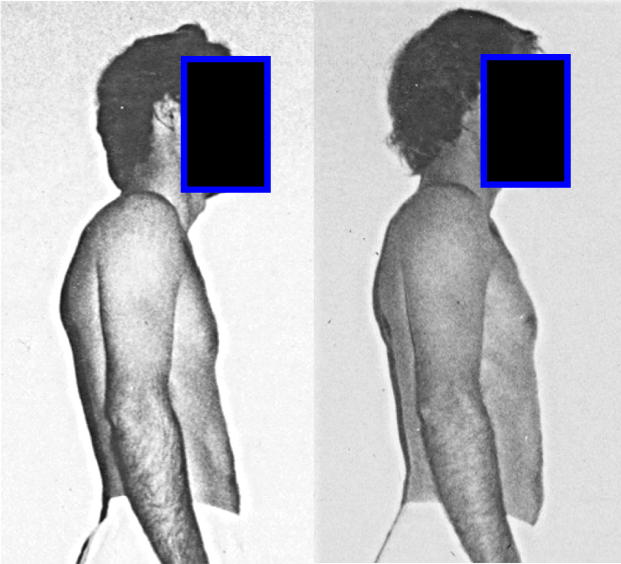
A runner working a 9-5 job always wanted to quit work and get his contractor’s license to build homes in his community, but lacked the self-confidence to take the first step. After we doubled his chest expansion, he quit his job, got his license, and is now happily building homes while making far more money than his old job. Here are his before and after photos showing the resting expansion of his chest.
Chest Expansion and Self-Confidence
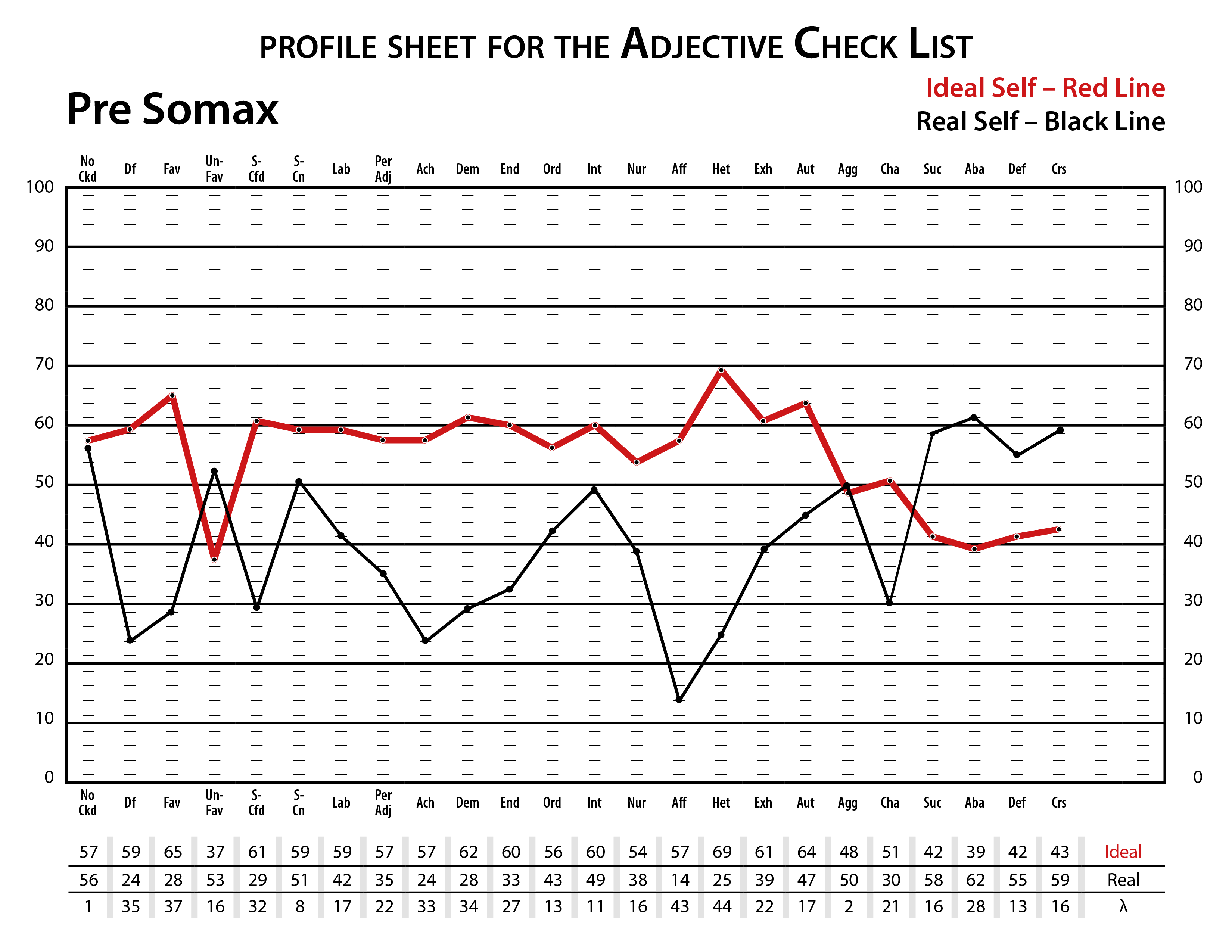
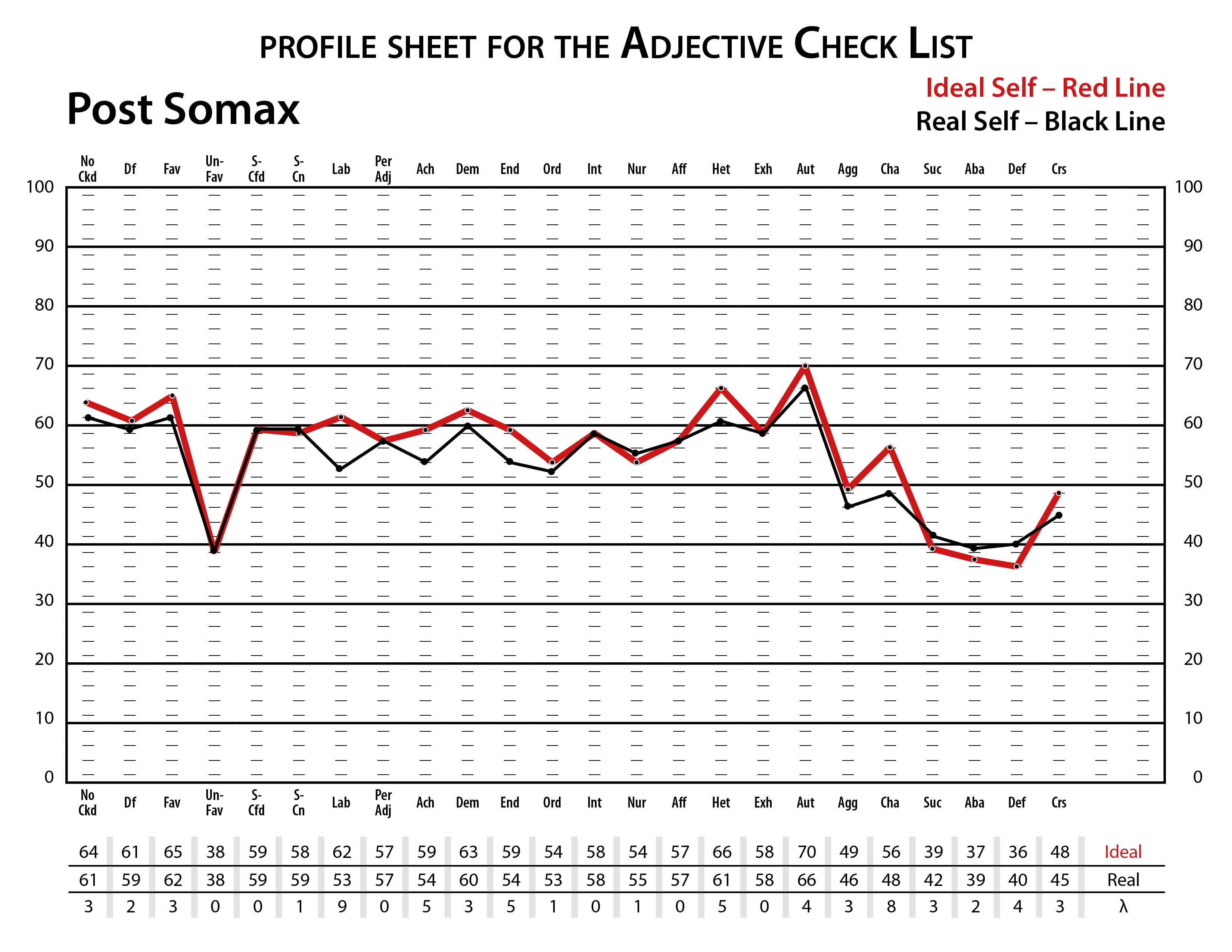
Two psychologists tested a group of ten runners with the Adjective Check List twice before and after they doubled their chest expansion at Somax. The ACL is a list of several hundred adjectives. The first time they took the test, they were instructed to check off those adjectives that applied to their real self. The second time, to check off those adjectives that applied to their ideal self. After they completed their Somax program, they were tested the same way once again.
The psychologists were amazed at the magnitude of change. The runners (who were already getting more oxygen than average from their five-mile daily runs) showed marked improvement in self-confidence, self-esteem, autonomy, self-control, sociability, nurturance, perseverance and dominance, with equally large drops in abasement, deference and sympathy-seeking. Here are the before and after graphs of one of the runners who achieved her ideal self in just four weeks.
|
||
$35 US/$55 Non-US |
||
|
||
|
||
|
||
Measuring your breathing ranges is more important than measuring your weight. Your breathing ranges affect every part of your health, but most importantly, affect how well your brain functions.
Order your Somax Measuring Kit and measure everyone in your family. Each kit contains our six page instruction manual for measuring and calculating your breathing range percentage, a demonstration video and a flexible cloth tape measure. The kit is only $35 in US and $55 outside US, which includes Priority Mail postage and handling.
Microfibers
Chronic tension can easily occur in the muscles of the stomach and chest from seemingly innocuous events such as carrying a school backpack, non-serious sports impacts, bench presses, sit-ups, falls, getting the wind knocked out, colds, flu, bronchitis, pneumonia, texting, video games, computer work and stress. This tension, whether we are aware of it or not, causes microfibers to form in the connective tissue between the muscles. These microfibers are a mild form of adhesion or scar tissue. They form to immobilize the area so it can heal.
Unfortunately, once the area has healed, the microfibers not only do not go away, they tend to accumulate over time. They cannot be released by stretching. Since they are very small, the only way to know if you have microfibers is to measure your trunk wall flexibility.
We release microfibers with Microfiber Reduction, improving breathing ranges 2-10X. Our clients continue to improve their breathing ranges with our Tension Reduction exercises.
Microfiber and Tension Reduction
Microfiber Reduction is a proprietary form of connective tissue massage developed by Somax to improve flexibility far beyond what stretching alone can do. Tension Reduction is our special program to reduce tension. By releasing microfibers and tension in the trunk, we have been able to improve chest and stomach expansion 100% and more.
Microfiber and Tension Reduction are available to our clients in our individual programs, national team programs and camps.
Schedule and Appointments
Please contact us to discuss our chest expansion programs and schedule appointments.
|
||
$35 US/$55 Non-US |
||
|
||
|
||
|
||
Measuring your breathing ranges is more important than measuring your weight. Your breathing ranges affect every part of your health, but most importantly, affect how well your brain functions.
Order your Somax Measuring Kit and measure everyone in your family. Each kit contains our six page instruction manual for measuring and calculating your breathing range percentage, a demonstration video and a flexible cloth tape measure. The kit is only $35 in US and $55 outside US, which includes Priority Mail postage and handling.